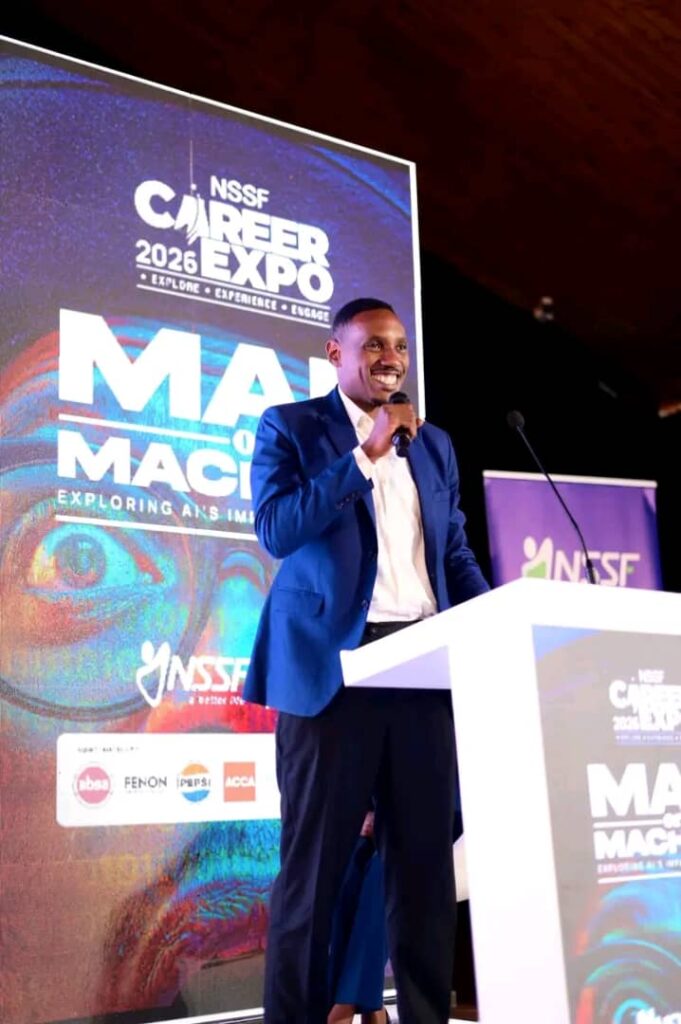



By Victor Turinawe
Students at Uganda Christian University (UCU) have been urged to embrace artificial intelligence (AI) as a tool not only for job seeking but also for job creation in an increasingly digital economy.
Rhoda Musiima, Chief Executive Officer of Phos Creatives, encouraged students to embrace adaptability as they transition from job seekers to job creators. She emphasised that AI should not be viewed merely as a content generator but also as a tool for building strategies, analysing business models, and accelerating innovation.
This call was made on March 25, during the one-day NSSF Career Expo 2026 held at Nkoyoyo Hall at the Mukono campus. The expo, organised by the National Social Security Fund Uganda (NSSF), was held under the theme “Man or Machine: Exploring AI’s Impact on Careers”.
Musiima encouraged aspiring entrepreneurs to use AI to study leading companies and apply successful strategies to their own ventures. She also highlighted the importance of adaptability in professional environments, noting that while authenticity is important, individuals must be willing to adopt technological tools to effectively navigate negotiations, presentations, and business environments.
John Ssenkeezi, Digital Supervisor at NSSF Uganda, advised students to embrace data analysis as they prepare for the future workplace. He explained that data is the driving force behind AI systems and helps organisations understand customer behaviour through website interactions, browsing patterns, and engagement levels.
“Even basic tracking technologies can reveal where users focus their attention and what influences their decisions,” Ssenkeezi said, adding that such insights help organisations improve their services.
During a panel discussion, Isaac Odongo, Chief Executive Officer of ROAS Digital and AI, urged students to interact with AI tools while refining outputs in real time to ensure continuous improvement of content rather than generating disconnected responses. He noted that strong AI communication skills are increasingly in demand as organisations seek individuals who can effectively work with these tools.
Speaking on how NSSF itself is using AI, Barbra Teddy Arimi, Chief Marketing and Corporate Affairs Officer at NSSF, said the fund is increasingly leveraging artificial intelligence and digital technologies to improve service delivery, ensure efficiency, and better serve its members. She explained that NSSF’s value proposition is built on three key pillars: safety of members’ funds, convenience, and empowerment.
“In the past, processes like member registration were done manually, but we have since transitioned to automation, and now we are moving further into artificial intelligence,” she said.
The session also saw students advised to improve their academic qualifications. Emmanuel Siiya, Business Relations Officer at the Association of Chartered Certified Accountants (ACCA), encouraged them to add professional qualifications to their degree certificates and transcripts. He noted that ACCA is accessible to people from various academic backgrounds, provided they have completed secondary education and are interested in finance- related careers such as ICT, law, and accounting.
The one-day NSSF Career Expo was attended by students from the Faculty of Engineering, Design and Technology, the School of Business, and other faculties, providing a platform for learning, networking, and preparing for the future of work in an AI-driven world.