

By Racheal Atuhaire
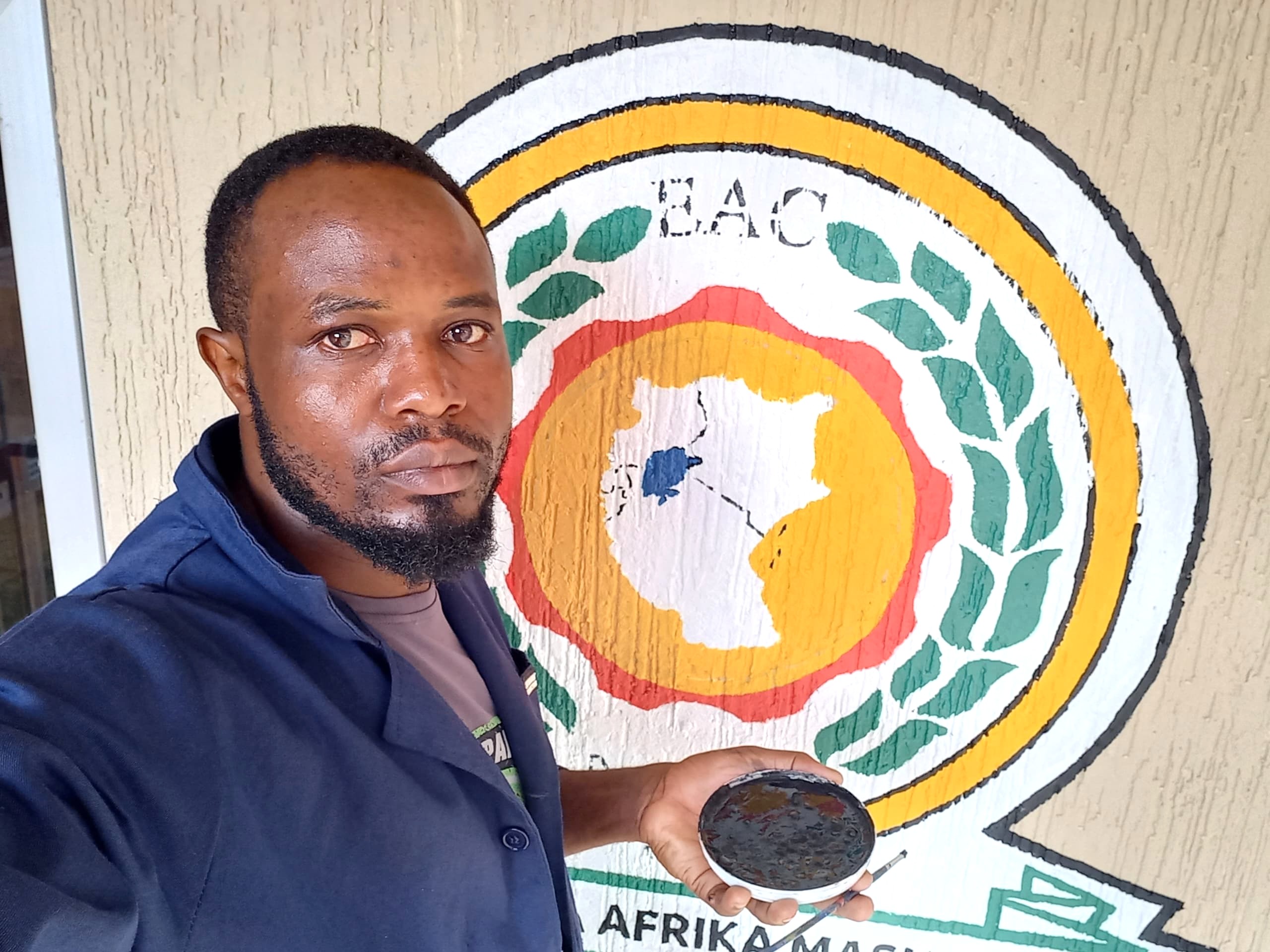
On any ordinary day, Moses Kamagara can be found navigating the busy roads on his boda boda, weaving through traffic, carrying passengers from one place to another. He is stationed in Mukono at Wandegeya Stage near Uganda Christian University (UCU) first gate, where he operates from as he waits for passengers. But behind the helmet and the dust of the road is a different man, an artist with a paintbrush, a vision, and a dream that refuses to die.
Kamagara is a graduate of Industrial Fine Art from Uganda Christian University (UCU), where he enrolled in 2017. Like many art students, he left university with talent, skill, and hope. But unlike what many people expect, the world after university did not open doors immediately. Instead, Kamagara created his own.
“I paint mainly when I get a job,” he explains. “When there is no painting work, I ride boda boda”.
His life now moves between two worlds, the road and the canvas. When a client calls, he parks his motorcycle and picks up his pencils and brushes. He draws cartoons for schools, paints walls, and makes portraits for people celebrating birthdays or special occasions. For a full painting job, he earns between Shs800,000-900,000, but the work is not regular. Some months are good; others are dry.
To survive the dry months, Kamagara bought his own boda boda. Unlike many riders who rent motorcycles, he owns the one he rides, giving him a more reliable source of daily income. During a good period, he says, he can make about Shs200,000 from boda operations every two weeks
But even with the hustle, his heart remains in art.
“Painting is what I have always wanted to do,” he says. “I have an eye for art.”
Kamagara dreams of starting an art centre equipped with machines and tools such as a Direct-to-Garment printer and a pre-treatment machine so he can print designs on T-shirts, caps, and other materials. He wants to create a space where art is not just a talent, but a business and a community where other artists can work and grow.
However, the journey has not been easy.
When COVID-19 struck, Kamagra says it “took a lot of my life.” Before the pandemic, he had a business and even a chapati stall that were running well, but they were badly affected and collapsed during the lockdown. Like many Ugandans, he was forced to start again from scratch.
In his painting work, one of his biggest challenges is pricing. Sometimes he does not calculate the cost of materials, time, and effort properly. By the time the work is finished, the money left is too little, and it almost feels like he worked for free. At times, clients ask for extra work that was not agreed on, and because he does not want to lose the customer, he absorbs the extra costs himself.
On the road, he faces another challenge, corruption. He says police officers sometimes stop him and ask for money, and in some cases take his boda boda, forcing him to pay money to get it back.
Despite all this, Kamagara keeps moving, both on the road and in his dream.
His message to students, especially those studying art and other courses, is simple: use the skills you have and learn from people who are already doing what you want to do. Do not just wait for formal employment. Start from where you are, with what you have.
Above all, he emphasises discipline.
“Make sure you are disciplined,” he says. “Because no one wants to employ someone who is not disciplined.”
As he rides through the town looking for his next passenger, Kamagara is also, in a way, riding towards his dream, one trip, one painting, and one opportunity at a time.
