

By Timothy Okurut
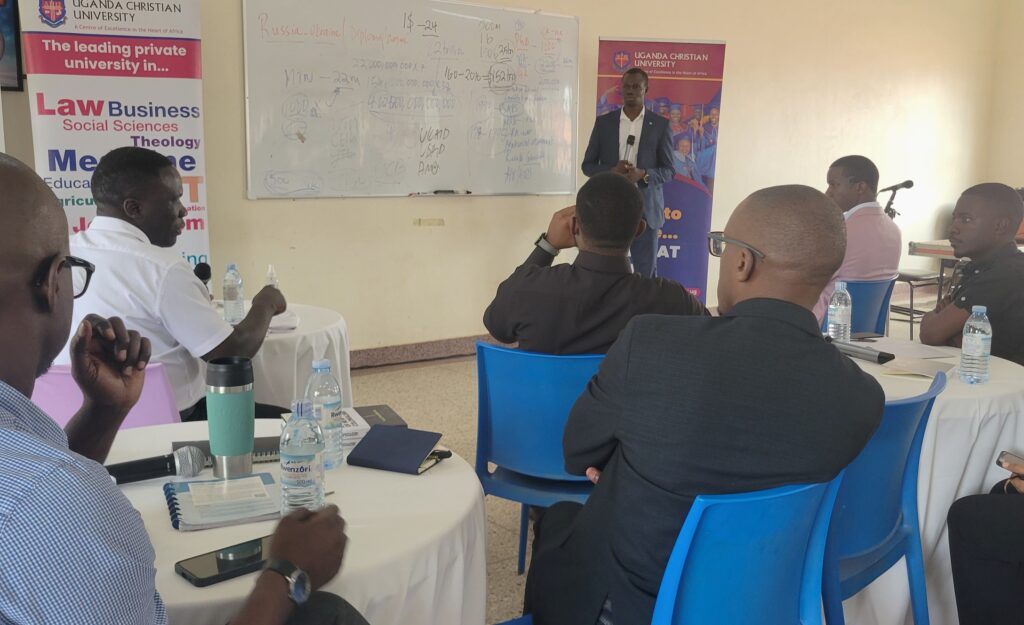
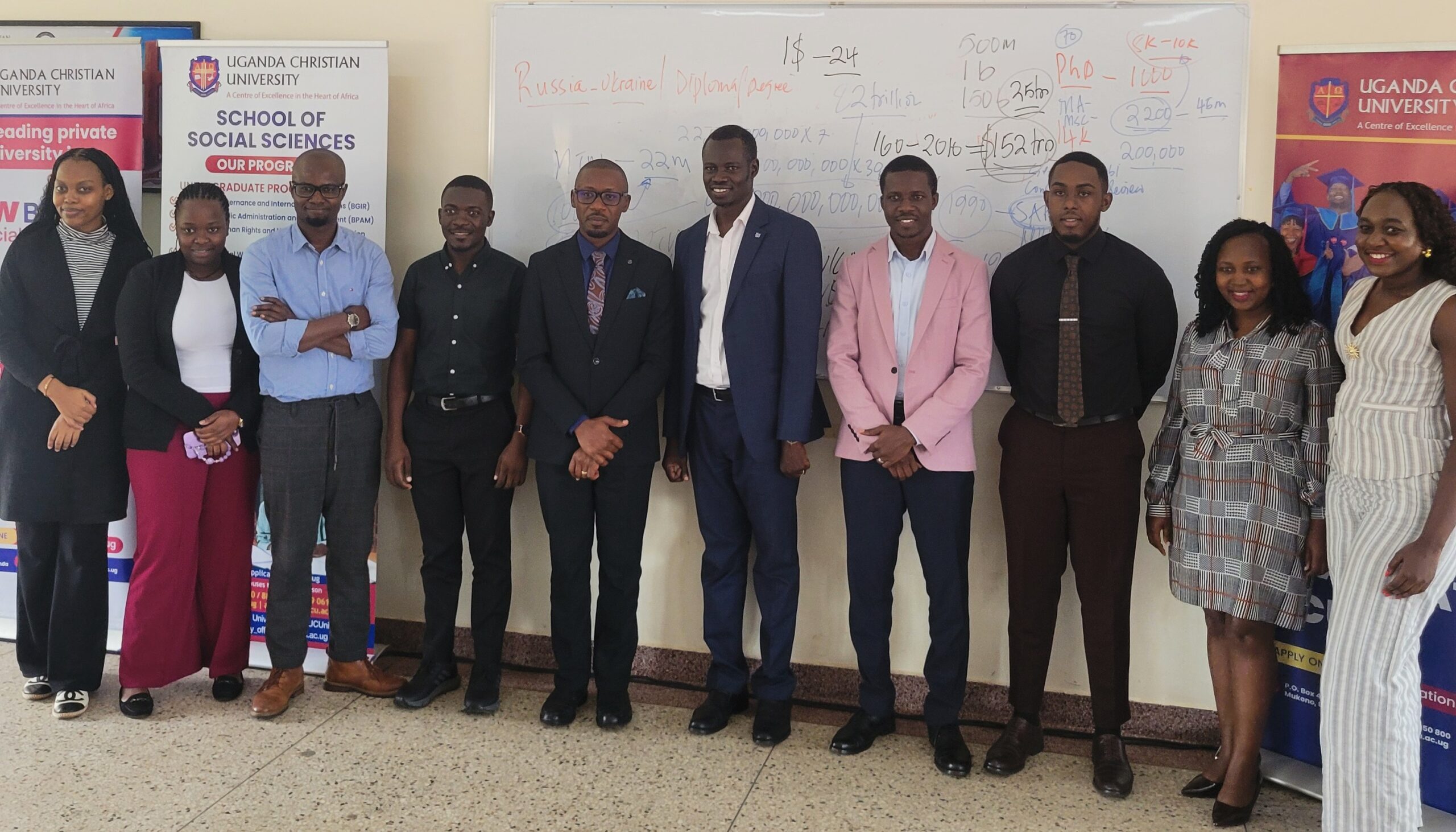
The School of Social Sciences of Uganda Christian University today conducted a public dialogue in which scholars were challenged to think about nationalisation as a key model in development. The dialogue that was held in the John Senyonyi Building on the Kampala campus was conducted as part of an assessment for the students pursuing a Master’s in Governance and International Relations (MGIR).
In his keynote speech, Dr Yusuf Serunkuma underscored the fact that most of the multinational companies making the biggest profits in Uganda were once state-owned but later privatised.
“The argument was that if they’re sold to individuals, they’re more profitable; of course it was a lie,” Serunkuma said.
He further argued that the privatisation agenda has left African governments, including Uganda’s, with a funding gap that has sent them into heavy borrowing and reliance on donations, which he believes comes at a cost.
“Nothing comes without a cost,” Serunkuma said.
Serunkuma said the dependence on foreign donors has created a chain of ambassadors who are loyal and freely support foreign interests. These in turn repatriate more funds than they give in donations.
“For every one dollar that they give to us, the giver through a longer process takes back twenty-four,” he said.
Alex Kisakye, a student of the class, said that the discussions in this engagement caused him to ponder why and how we took this turn as a nation. He reiterated Serunkuma’s stance as he stated that African economies end up in debt even after donations due to the law of reciprocity.
“Even if someone gives you something small, they owe you in some way,” Kisakye said.
He further explained that the media has played a role in causing us to downplay the potential we hold, particularly by promoting narratives that suggest success and opportunity are primarily found in Western countries rather than in Africa.
“From the movies that we’ve watched, we’ve always fantasised about the US, Europe, and China, so it became gradual in our thinking that the best is not here; it is out there,” he added.
Rogers Tumusiime, another student in this class, pointed to loopholes in our education curriculum as one of the major causes for this dependency problem.
“In layman’s terms, it teaches you how to consume sugar, but it doesn’t teach you how to produce it, so if you need sugar, you have to go to someone who knows how to make it,” Tumusiime said.
Rev. Dr Simon Feta, who also chaired the discussion, probed the students with the question of how the country and the continent can nationalise the existing multilateral companies back into their control.
“Multilateral companies in the capitalistic design employ states, as opposed to states working with multilaterals.” He therefore tasked the students with thinking of ways for how the state can regain control of these companies.
Uganda Revenue Authority’s (URA) last revenue collection stood at shs. 31.63 trillion. That was also the highest figure the URA had collected; however, Parliament passed a shs. 72.376 trillion budget, which meant that the government was dealing with a huge deficit in the budget. The discussions held at the social science dialogue point to a solution that could reduce the repatriation of funds from Uganda and other African nations to help them increase their domestic revenue.