


By Bill Dan Arnold Borodi
Richard Mutebi Miro was a man of many exploits during the time he was a student at Uganda Christian University (UCU). He was a student of Accounting in the School of Business and obtained a first-class academic record, served as Guild Vice President in the 26th Government, and participated in various sports, clubs, societies and fellowships, In this interview, Miro reflects on his years at UCU.
Q: What did serving as Guild Vice President teach you?
A: I came to appreciate the role of a student leader more in advocating for students’ welfare. Sometimes there is an assumption that student leadership is just for formality. But some of the things we advocated for were actually implemented. We advocated for paid internships for continuing students, an increase in the tuition fund and rehabilitation of the halls of residence. One of the biggest realisations for me was that the voice of a student leader actually counts in the day-to-day running of an institution. There was a time when the university changed its security service providers and some of the new security personnel were very harsh towards students. Some students were even choosing to stay in hostels. We had a conversation with the head of security. We told them that we understood the new security personnel had expectations to meet, but students also had to be treated as clients. That was eventually addressed.
Q: There was a perception that you sometimes appeared to be the de facto Guild President. Why was your role so prominent?
A: I get that a lot. When I was appointed, the president was in her final year and her priority was to finish her studies. She delegated a lot of responsibilities. At some point I realised I had a lot on my plate. I decided that, constitutionally, my role was to support the president. Some of her weaknesses were some of my strengths, so I made the decision to be more present and available.
At the time, my personal mantra was “leadership as a service, not as a status.” I applied for a dead semester, but after consulting the faculty, I discovered that because of the academic disruption caused by COVID-19, it would effectively become a dead year. I therefore decided to use that time to support the Guild government and make myself available. That is how the dynamic developed.
Q: Your campus life extended well beyond Guild leadership. You were involved in sport, clubs, debates and innovation. What drove that?
A: Before I entered Guild leadership, we were among the people who founded the Coffee Club at UCU. We were the first baristas, and we also advocated for a School of Business exhibition.
I was also involved in swimming. I was part of UCU’s first swimming team, but we faced a major disadvantage because the university did not have a swimming pool. When we went to compete at Makerere, we realised the disadvantage we had. We still managed to win a few medals. Later, I discovered that UCU had previously had a strong Scrabble team, but it had died out during COVID-19. So I helped revive it. We formed the first post-COVID Scrabble team and I eventually became captain.
Q: How did you manage all of this and still achieve a first-class degree?
A: Academics were always a constant. I was a discussion group leader. We had a popular discussion group that met in C4 every day from Monday to Friday during the semester. I was doing something I was competent at and loved. That helped. My lecturers also played an important role. Because they knew me through student leadership, there was an expectation that I would not abandon academics. After my leadership period, some lecturers would actually follow up when I missed class and ask where I was and whether everything was okay. I also surrounded myself with friends who could sharpen me academically. Having good academic peers helped me pull it off.
Q: What were some of the biggest challenges you encountered?
A: There was a period when tuition became an issue because I also had a sibling at UCU studying law. Fortunately, the issue was eventually handled. But another major challenge was criticism of the Guild government, particularly around the Prime Minister scandal. The difficult part was separating friendship from leadership. Someone can be your friend and still be a bad leader. Navigating that distinction was a challenge. We also had to work with the university administration to balance students’ interests with institutional concerns.
Q: What is one of the most memorable moments from your university years?
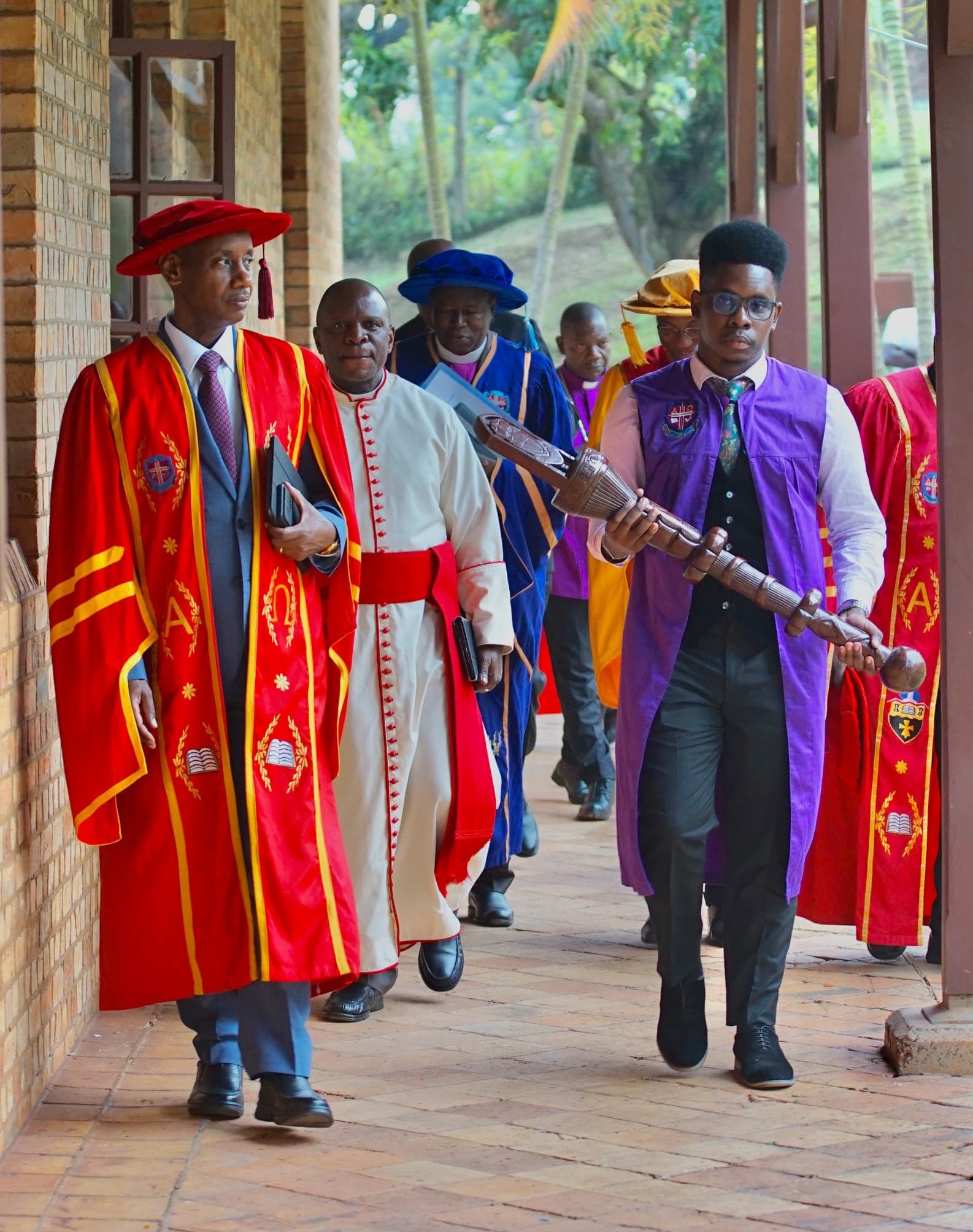
A: There are several. One was serving as a male misbearer (the official who leads the academic procession while carrying the university mace during graduation). I did not know that the Vice President was expected to serve as misbearer. Historically, the presidents were often men and their vice presidents were women, so having a male misbearer was unusual. That role allowed me to interact with the Chancellor, graduation guests of honour and members of the University Council. It became memorable partly because people recognised me easily. Another moment was winning a silver medal at the Makerere swimming competitions. Also, meeting the Head of State at State House was an experience I had never anticipated as a student leader. We presented several issues, including tuition fee differences between private and public universities, regulation of tuition increases and the long-delayed Mukono Road. It showed me the opportunities student leadership can create to raise students’ concerns at the highest levels.
Q: Why was it important for you to be involved in social events?
A: It helped me stay connected to students and understand their everyday experiences. Through inter-faculty games, clubs, fellowships and other activities, I could engage with students who were not always visible on campus and receive direct feedback on what the Guild government could improve.
Q: Your Afro has become part of your identity. How do you keep it neat, and what does it mean to you?
A: I keep it simple: I wash my hair with shampoo, including Movit, and rely on two trusted barbers, one in Mukono and another in Kampala. Good genes help, too! Beyond grooming, my Afro is a statement against stereotypes that associate unconventional hairstyles with unseriousness. I enjoy surprising people who judge me by my appearance before discovering my competence. My hair is part of what makes me memorable.
Q: Finally, what would you tell a student beginning university today?
A: Excellence has many colours. You can choose to be excellent academically. You can choose to be excellent as a leader. You can choose to be excellent as a sportsman. None of those versions of excellence is inferior to the other. If you want to pursue all of them, you can still be excellent at everything. University should not be about being one-dimensional. All those experiences combine to build your reputation. A good name is better than silver and gold.
