


By Victor Turinawe.
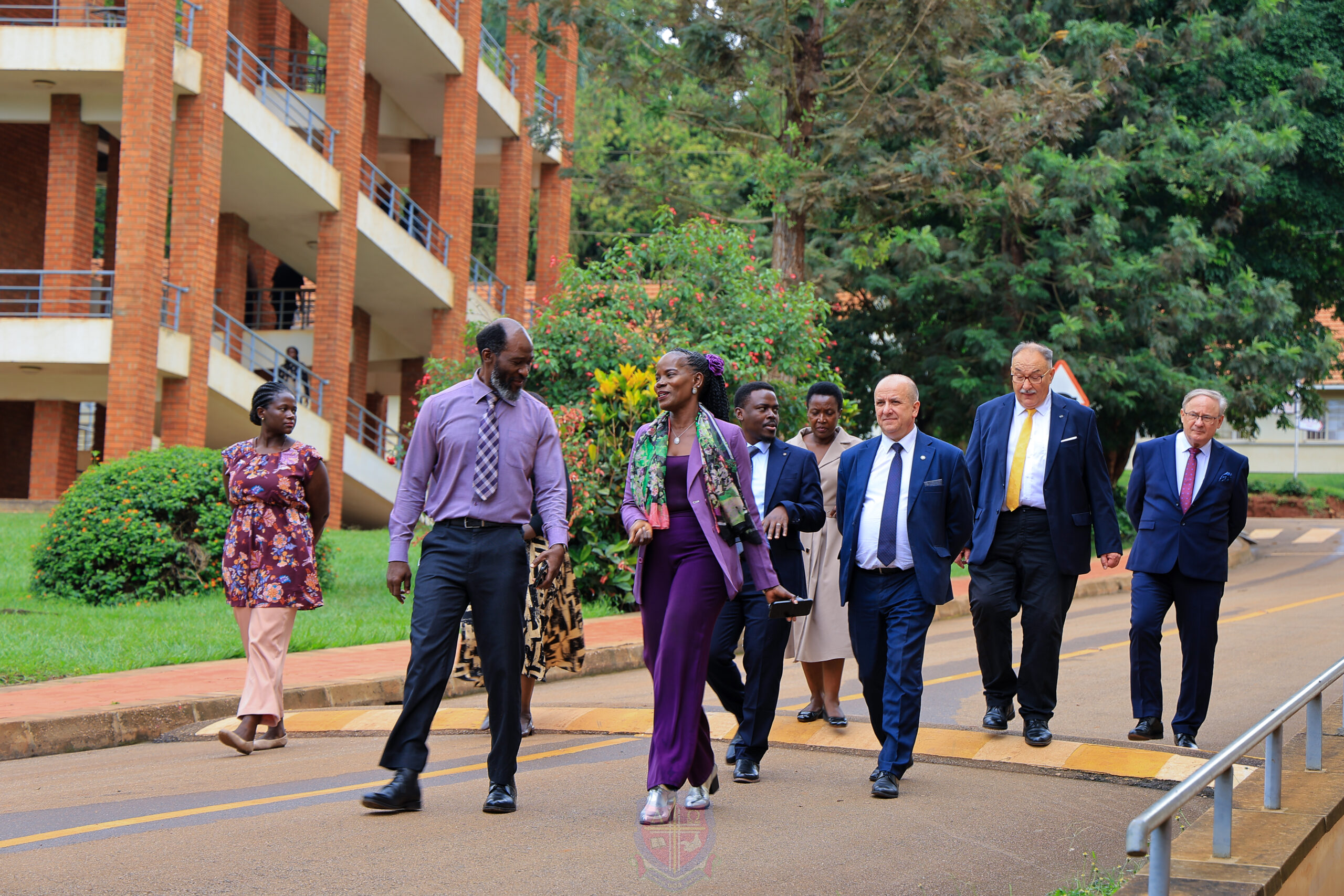
Representatives from Clark International University, Kabale University, Uganda Christian University (UCU) and Maria Curie-Skłodowska University (UMCS) from Poland have agreed on several potential areas of collaboration as part of efforts to implement a Memorandum of Understanding (MoU) signed last year.
During a meeting held at UCU’s main campus in Mukono Municipality on November 12, 2026, representatives from the four institutions discussed possible areas of cooperation, including joint research and educational activities, cultural exchanges, staff and student mobility, and the sharing of academic information and publications.
Speaking on behalf of Clark International University, Prof Rose Clarke Nanyonga said that the university received it’s charter in 2025, and it specialises in health sciences education, offering programmes in nursing and midwifery, public health, allied health sciences, education, business and applied technology.
Speaking during the meeting, Prof. Nanyonga said the university was interested in partnerships that would produce practical results rather than remain at the level of signed agreements.
“As a university, we specialise in health sciences, and we are interested in building partnerships that could translate into tangible achievements within the next three to five years rather than limiting cooperation to signing agreements,” Prof. Nanyonga said.
Meanwhile, Kabale University Senior Grants Officer Jacqueline Akello, representing Vice Chancellor Prof. Johnny Mugisha, said the institution was keen to strengthen research collaboration on environmental challenges affecting the Kigezi Highlands.
She identified the depletion of wetlands and papyrus vegetation as some of the environmental concerns that require further research and joint interventions.
Akello said Kabale University also intended to utilise its proximity to Lake Bunyonyi and the surrounding highland environment to strengthen research and development in ecotourism and environmental conservation.
“The university also intends to utilise its proximity to Lake Bunyonyi and the surrounding highland environment to strengthen research and development in ecotourism and environmental conservation,” Akello said.
Representing UMCS, Dr Sklodowska said the university was increasingly focusing on environmental issues, particularly climate change, which she described as an important area of academic research.
“You mentioned that one of your university’s research priorities is the analysis of climate change. This is also an important area of interest for our institution, and we approach it from several perspectives. For instance, climate change is an important subject from a political and policy perspective, represented at our university by scholars such as Professor Marek Pietrasz. From my own perspective as a physical geographer, climate change research is one of the most important areas of academic investigation,” Dr Sklodowska said.
UCU Vice Chancellor Prof. Aaron Mushengyezi said the proposed areas of cooperation were intended to establish a practical framework through which the participating institutions could move beyond signing Memoranda of Understanding and implement activities that deliver measurable results.
Other proposed areas of collaboration include internationalisation and public relations, particularly in law, business, governance and public policy; strengthening institutional governance systems through improved information technology systems, institutional policies and governance structures; and research into climate change and the circular economy.
The institutions also identified opportunities for collaboration in artificial intelligence applications in learning, physics and chemistry education for young learners, sports science, cultural experiences, and value chain studies.
In research and innovation, the universities proposed drawing on UMCS’s 24 research centres to undertake joint studies, alongside collaboration in public health and community engagement.
The meeting further explored short-term opportunities that could deliver immediate results, including Collaborative Online International Learning (COIL), hybrid mobility programmes, joint supervision of postgraduate students, thesis examination, joint academic paper writing, seminars, workshops and conferences.
Staff and student exchange programmes were also highlighted, with participants proposing to take advantage of Erasmus opportunities. Prof. Pietras was identified to take the lead in exploring mobility arrangements.
Other areas include sharing library resources, providing access to laboratories and research centre facilities, developing dual-degree programmes, organising Africa Day activities, and engaging university sports teams in competitions, games and coaching programmes.
The proposed medium- and long-term areas of cooperation include value chain development, particularly in food production, coffee, product development and logistics, as well as further collaboration in law and other academic disciplines.
The MoU was signed on October 8, 2025, between UMCS, represented by its Rector, Prof. Dr hab. Radosław Dobrowolski, and UCU, which signed on behalf of the participating Ugandan universities through Vice Chancellor Prof. Aaron Mushengyezi.
The discussions mark a step towards strengthening international academic cooperation, promoting research and innovation, and creating opportunities for staff and student exchanges among the participating universities.
