


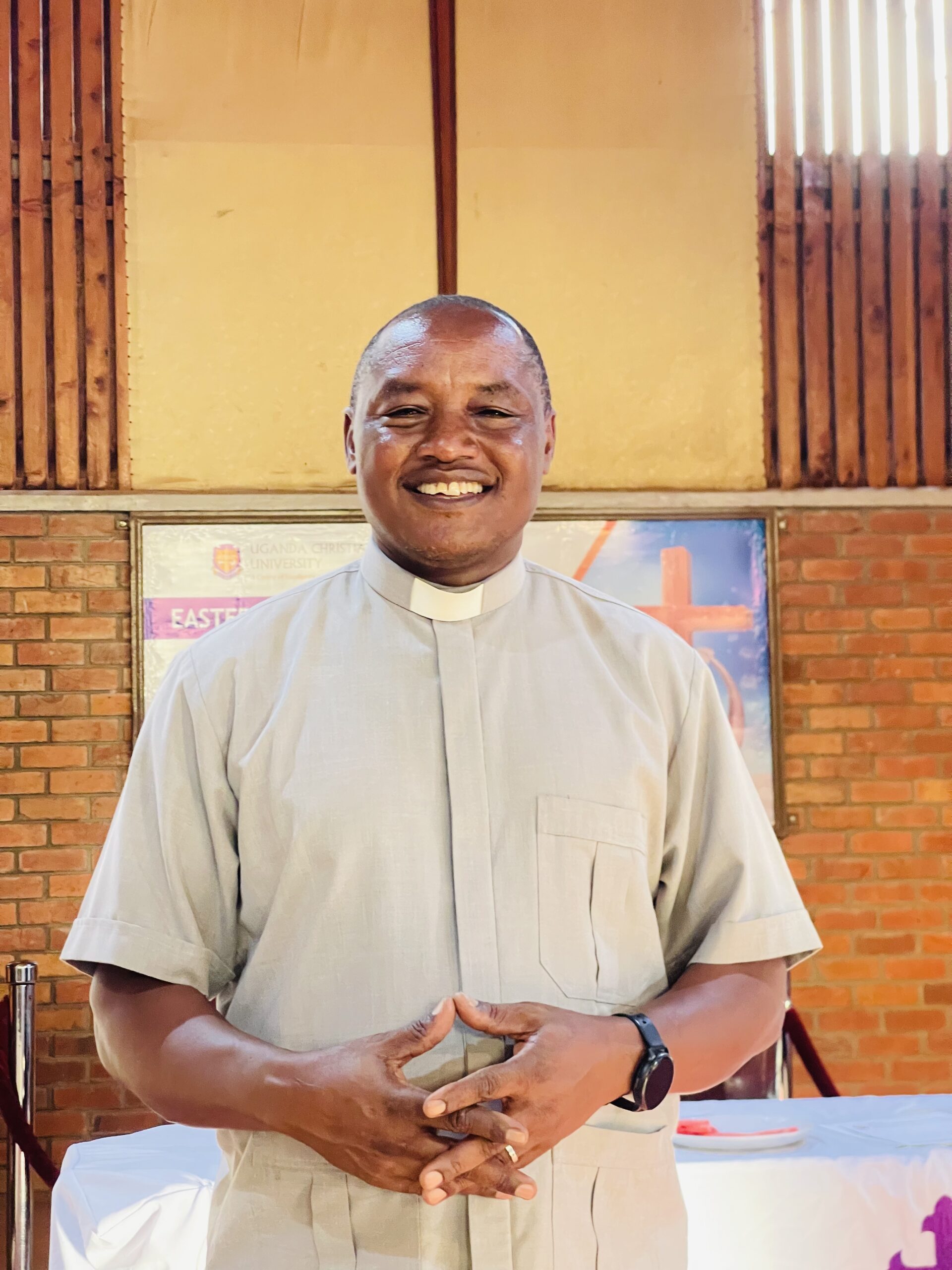
By Esther Nantambi
It is Wednesday morning, and exam week at Bishop Tucker School of Divinity and Theology. Rev Dr Moses Bushendish, the new Dean of the School, is not behind his desk issuing instructions. He is overseeing examinations, ensuring each session runs as it should and that any issues are handled in time. It is an ordinary moment, but it reveals something. He puts the work first.
Asked who he is beyond office, his answer is immediate. Before Reverend, before Canon, before Doctor, before Dean: “I am a Christian. Born again. In need of God’s saving grace.”
Only then does he turn to the rest, saying he is a husband, a father of five children of whom two are married, and three still in school. “I am still parenting.” It carries a quiet weight. Leadership, however far it reaches, still answers to home.
The turn
In the early 1990s, Bushendish was a teacher, trained at National Teachers College Masindi with a major in Agriculture. It was during his first posting at Sebei College that ministry began to take shape. As Scripture Union patron, he worked closely with students and began to witness change, not only in academic performance and behaviour, but also in the feedback of parents who said their children were improving.
Sensing the pull towards ministry, he came up with what he now calls—with a touch of self-mockery—a “very good plan.” “Let the Ministry of Education pay my salary, and I serve God on weekends.” It seemed the perfect arrangement: steady income, family provision, and room for ministry. With that, he joined Bishop Tucker School of Divinity and Theology.
In 2002, after graduating with a first-class degree, he began teaching while serving as he had envisioned. But the arrangement lasted only two years. As the call to full-time ministry deepened, he realised the two paths could not continue side by side. Just then, his salary was increased nearly threefold.
“It became a real test,” he says.
What steadied him was a passage he knew well. In Mark 10, Peter says, “We have left everything and followed you,” and Jesus responds that no one who leaves their house, family, or land for the sake of the gospel will fail to receive a hundredfold, even with persecutions, and in the age to come, eternal life. He resigned and stepped into ministry full-time in Sebei Diocese as the Diosesan Planning and Development Officer.
The beginning without support
What awaited him was a structure still to be built. “There was no office,” he says. “No room. No desk. No electricity. Even the account that was there was dormant.”
It was a beginning without the usual support,yet rather than seeing absence, he saw possibility. “I told people, you will see this diocese employing people.”
Bushendish started working alongside the bishop and the Diocesan Secretary. Their routine was demanding. By 6:30 in the morning they were already at work, and often he would leave at midnight.
There, he began designing and implementing strategic plans, leading community transformation projects, and spearheading fundraising and implementation.
How to start in an office without much in place
“For me, it starts with a problem assessment,” he says. “What are the issues? Why are you in that office?” Once the need is clear, solutions begin to take shape. If a community lacks water, then the task is to bring it within reach. That means planning carefully, securing resources, and identifying those willing to help.
“I found that many people and organisations want to help, if only they are shown a clear way to do so.”
For some, that is where the work ends. For him, it did not.
“When you get resources, make sure you implement.”
He pauses, then adds, “Resources and results share the same table.” As you look for funding, Bushendish says you may find an organisation that says, “We don’t fund water, only agriculture.” So you ask, what if the water is for irrigation? You then regroup, reassess the area, identify where the need is, and find a way to help the people there. “They call it strategic thinking,” he says.
Soon, the projects he was handling began to attract significant funding. The needs around him were many: poverty, poor farming methods, Female Genital Mutilation, and families unable to feed or educate their children. Addressing such problems required vision, resources, and the right handling of money.
Money, Integrity, and the Test of Leadership
When it comes to money, his starting point is simple.
“Never put yourself first. Put the work first.”
For him, ministry begins with personal investment. “Be the first investment. Invest yourself. When the ministry grows, the ministry takes care of you.”
“The real pay cheque is not the money on your account. It is the lives you have transformed.”
Practical needs, however, are not ignored. When carrying out a project, he says, “You take care of fuel, transport, and a lunch allowance. And the volunteers you engage, pay them.”
That conviction was tested. An anonymous letter accused him, the bishop, and the Diocesan Secretary of benefiting from diocesan funds. “I told the bishop, it is possible the diocese has now received recognition, and people want to benefit. Now we have finished the phase of sacrifice. It is time to include people so they can appreciate the journey.”
So they began to involve the governance structures, engaging the planning board, diocesan council, and synods.
When he presented a budget of 89 million shillings, many were surprised. “They asked, ‘You mean that is in this diocese?’” He explained, “You don’t have to have the money at once. The trick is to do the work stage by stage, project by project.”
Here, he returns to the same process: identifying the problem, finding a possible solution, developing a clear plan, and sharing it with stakeholders willing to commit resources to see that vision implemented.
There were moments he nearly walked away. “Many times. The hardest moments are when people are interested in the money and not the work.”
At one point, he considered leaving ministry altogether, but stayed, encouraged by his wife and senior clergy.
Even efforts to help vulnerable children sometimes met resistance when assistance crossed denominational lines.
“For we are taking pains to do what is right… in the eyes of men” (2 Corinthians 8:21), he adds. “It is not an easy thing.”
Bushendish worked in Sebei Diocese for seven years. In 2009, his work there led to his appointment at the Church of Uganda Provincial Office in Namirembe.
He began as a Programmes Officer in Planning, Development and Rehabilitation (PDR) and later rose to become Director. During his time there, he was also instrumental in the renaming of the office to the Directorate of Household and Community Transformation.
He later moved to Church Mission Society Africa, where he has served at a continental level from 2018 to 2026, supporting churches in discipleship, stewardship, and mission strategy.
The work continues.
At Bishop Tucker School of Divinity and Theology, where he resumed leadership in Easter Semester 2026, his vision for theology students is clear: Inform. Form. Transform to Perform. This vision is inspired by Acts of the Apostles 1:8.
At its core is a strong theological conviction. He wants the School to stand as a centre for orthodox theology within the Global Anglican Future Conference (GAFCON), not only in what it teaches, but in what it carries. “Fire must burn in theology students,” he says. “Not just theology. Their presence should be felt within the community and through their performance outside.”
Within the School itself, the vision is equally deliberate. Staff are expected to grow in research and publishing, strengthening the academic foundation at a time when senior faculty are advancing in age. For him, the question of relevance remains direct. “If Bishop Tucker School closed today, what would the university miss?” The answer, he believes, should be unmistakable.
It does not end in Mukono. What is built at Bishop Tucker, he insists, must be reflected across its affiliated colleges including Uganda Martyrs Seminary Namugongo, Bishop Barham University College Kabale, UCU Mbale University College and Kabalega College Masindi . “Because they are Bishop Tucker,” he says.
The same standard must carry forward.
