


By Victor Turinawe
Environmentalists from the Environment Governance Institute (EGI) Uganda have encouraged students at Uganda Christian University (UCU) to think critically about how research can help address climate change and expand access to clean energy.
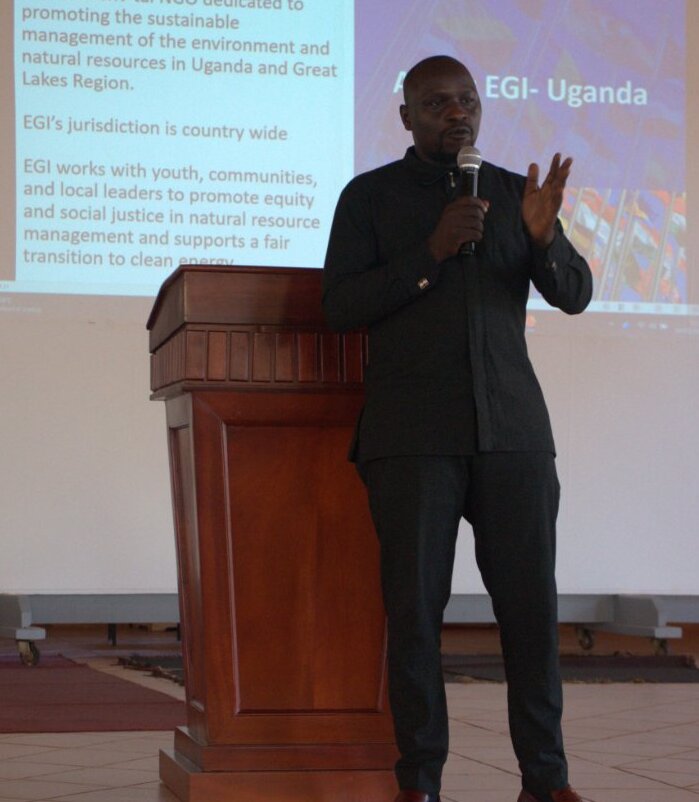
The environmentalists, led by the EGI. Uganda Programs Coordinator John Peter Okwi and Samuel Okulony, encouraged the students during the public lecture titled ‘Understanding Mission 300’, themed ‘What it means for a Just Energy Transition in Africa’. The lecture was held on the university campus in Mukono Municipality.
“Although energy production contributes significantly to greenhouse gas emissions, Africa must find ways to increase energy access using cleaner and more sustainable technologies,” said Okulony, a facilitator from EGI. Uganda.
Okulony further explained that, “Mission 300 was created in response to two major global challenges: energy poverty and climate change. Across Africa, more than 600 million people still lack access to electricity and clean energy, limiting economic growth, education, healthcare, and overall development. At the same time, climate change continues to affect livelihoods, agriculture and vulnerable communities.”
The session highlighted Africa’s unique position. Despite possessing enormous energy resources, including vast solar potential and significant oil and gas reserves, the continent continues to experience widespread energy poverty. Africa accounts for nearly 20 per cent of global oil production and has one of the world’s highest solar energy potentials, yet receives only a small share of global energy investment.
While responding to key questions raised by students, led by Charles Tumusiime, an Engineering student, concerning the proper utilisation of mobilised resources, Okwi answered that it is the responsibility of the government to ensure that the funds are used effectively and transparently.
Okwi further told the students that participating in research aimed at attaining clean energy would present opportunities for young engineers to innovate and develop home-grown solutions. He added that young people can play a role in shaping Africa’s energy future through innovation, research and active participation, as Mission 300 aims to connect 300 million Africans to electricity by 2030.
“Innovation should not stop at solar energy alone. Students should explore other renewable energy technologies and identify practical solutions to local energy challenges. Every problem presents an opportunity for innovation. University should not simply prepare you to look for employment. Instead, it should equip you to create projects that generate income, create jobs and solve community problems.”
Tom Wanje, a lecturer from the Faculty of Engineering and Technology (FEDT) at UCU, asked the environmentalists to also organise a students’ symposium to allow various categories of students to participate.
“If you seek innovation from engineering students, what about law students who should be coming in to apply energy laws, especially how and when, and hence it can avail a platform for creating employment opportunities,” said Wanje.
Mission 300 is a World Bank Group and African Development Bank initiative to accelerate electricity access in Africa by 2030. The public lecture was organised by EGI. Uganda in conjunction with the Faculty of Engineering and Technology (FEDT).
